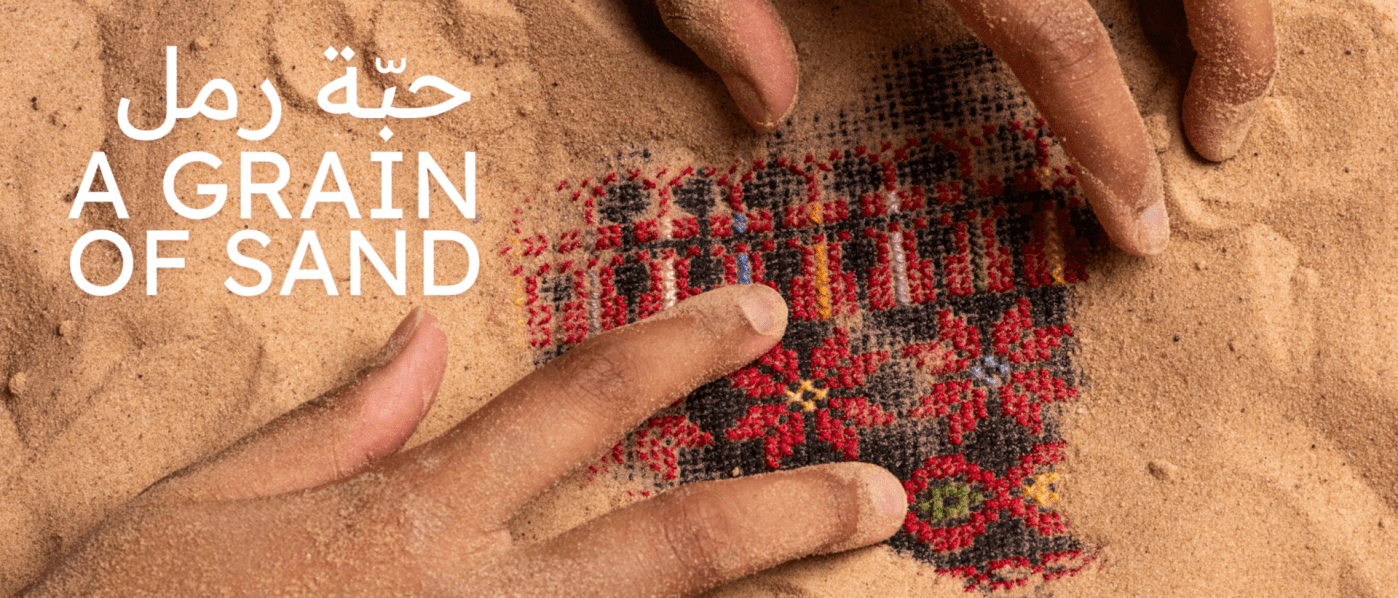
After a couple of fairly frivolous productions since the turn of the year, I was made to connect with the ‘real world’ in this one-woman show concerning life in Gaza as seen through the eyes of the children who live, and die, there. Rather than being a diatribe against the conflict per se, it focussed on the way hostilities are affecting the most vulnerable and innocent inhabitants of the area.
This play could have been a lecture as to the current state of this part of the Middle East as the latest developments in a war which has raged in one form or another since biblical times and, sadly, shows no sign of abatement, it was anything but. This was because of the construction of the work in which co-deviser, Sarah Agha, an Irish Palestinian actor, writer and broadcaster, presented the audience with the writings and musings of children in Gaza in such a way as to bring out the innocence, fears and humour inherent in them. The play was written and directed by Elias Matar, based on a collection of poems and testimonies called A Million Kites compiled by Leila Boukarim and Asaf Luzon.
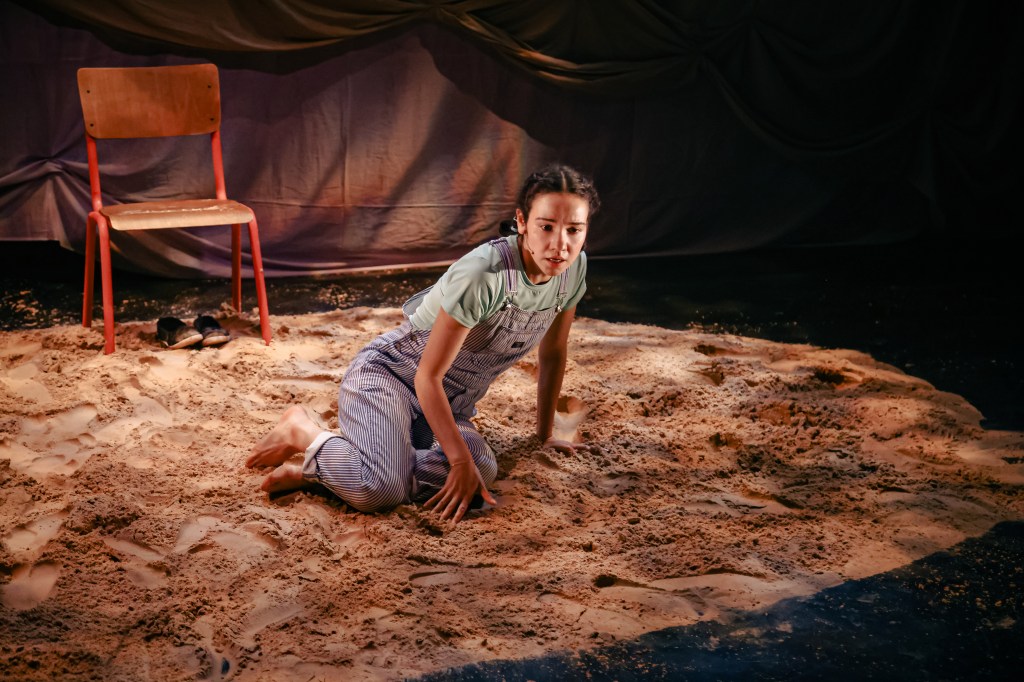
Sarah Agha as Renad, on the ‘beach’. Photograph by Amir Hussain
I will begin by describing the set, as it was an integral part of the action, rather than just a mood setter. There was a pile of sand in the middle of the stage, signifying the beach, with a structure to the rear of it from which was suspended a couple of pieces of tattered material acting as a screen onto which was projected images, and the names and ages of each of the contributors as their words were conveyed. The other prop was a solitary chair.
The show began with Ms Agha introducing herself as Renad, an 11 year-old girl living in Gaza who wanted to follow in her grandmother’s footsteps as a storyteller. She had held this ambition since hearing her relate the tale of the Palestinian Phoenix, Anqaa, which would fly above the clouds, approach the sun and plummet to the earth in flames, only to rise again from its ashes.
Renad had become separated from her parents and siblings so was on a journey to find them, during which she encountered other children who shared their experiences with her. There were far too many to relate individually, but a couple which stuck in my mind were the ones which illustrated that we have more traits in common with each other than we have differences.
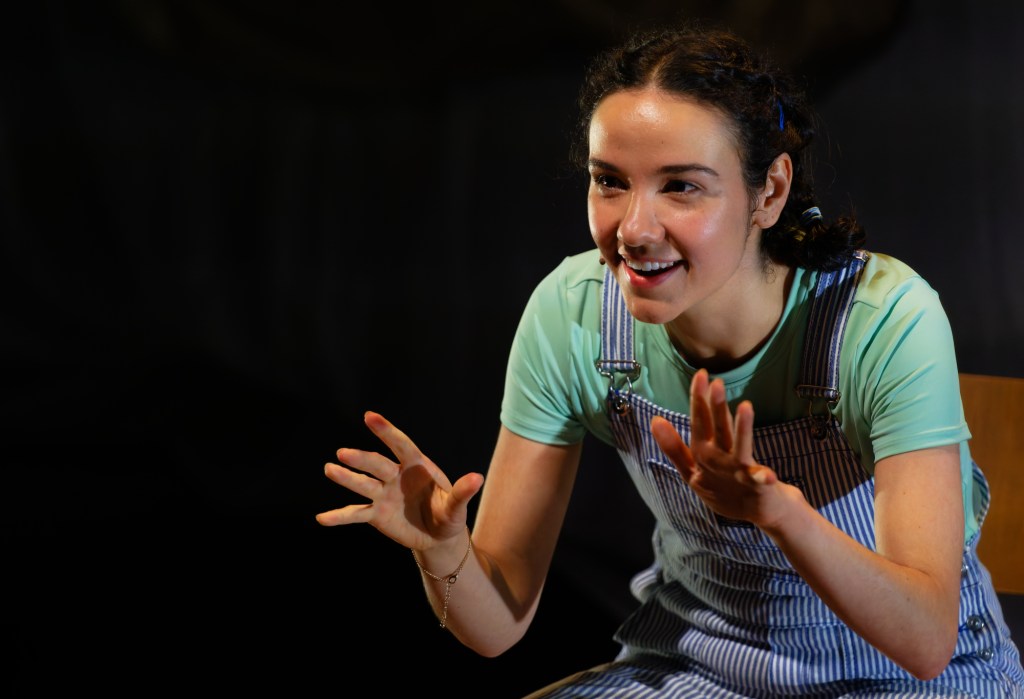
Sarah Agha relating one of the lighter stories. Photograph by Alan Blundell
There was one concerning two sisters, one rich and one poor, which entailed the use of the word ‘fart’ eliciting guilty laughter from her audience in the camp where they had been watching clowns. Another found a child, who had not eaten for days, witness objects fall from the sky and into the sea, which, for once were not shells, but aid parcels from which she took a can of beans to eat, leaving the rest for others in need. They were quickly snaffled up by hoarders making her wish, a couple of days later, when no more food had been available, that she had taken two.
The postscript to the above tales was that the camp was destroyed by bombs the following day, and some of the larger crates containing aid had dropped onto tents killing and injuring the occupants they were supposed to be relieving.
The culmination of the show was the displaying of names and ages of the children who had imparted their experiences to make up the book, it began with about twenty or so but as the projection zoomed out the list became ever longer and wider until the names were so small as to almost become illegible.
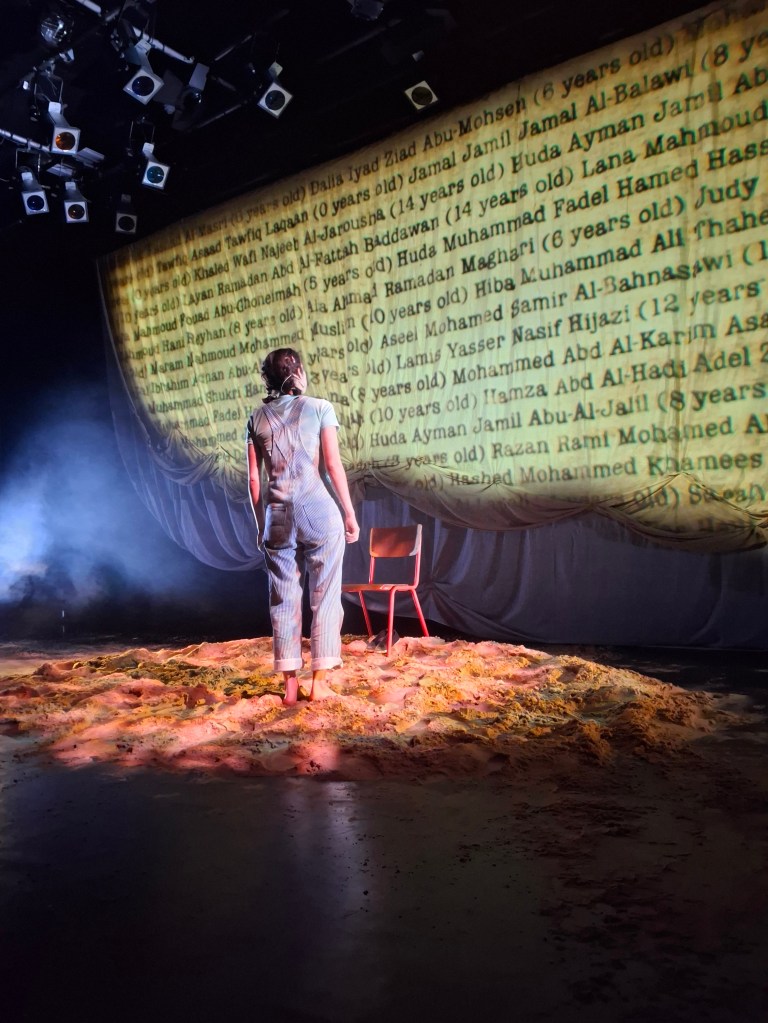
The ever growing list of contributors. Photograph by Toufik Douib
Sarah Agha was absolutely magnificent in this role, shifting from acting like an innocent child messing about on the beach, moving on to conveying a range of emotions whilst becoming the other children involved, and dropping her voice by an octave when impersonating her grandmother telling stories.
The message taken away was that, as in all conflicts, it is the innocents who suffer the most and those who did not lose their lives, limbs, senses or minds, still ended up being deprived of their childhoods having to deal with grotesque circumstances alone.
A Grain of Sand is a Good Chance production and, although having moved on from Leeds Playhouse, is on tour, so please check out the dates at https://www.goodchance.org.uk/agrainofsand where you can find out more about the company.
To see what else is coming to Leeds Playhouse it is https://www.leedsplayhouse.org.uk/whats-on/

